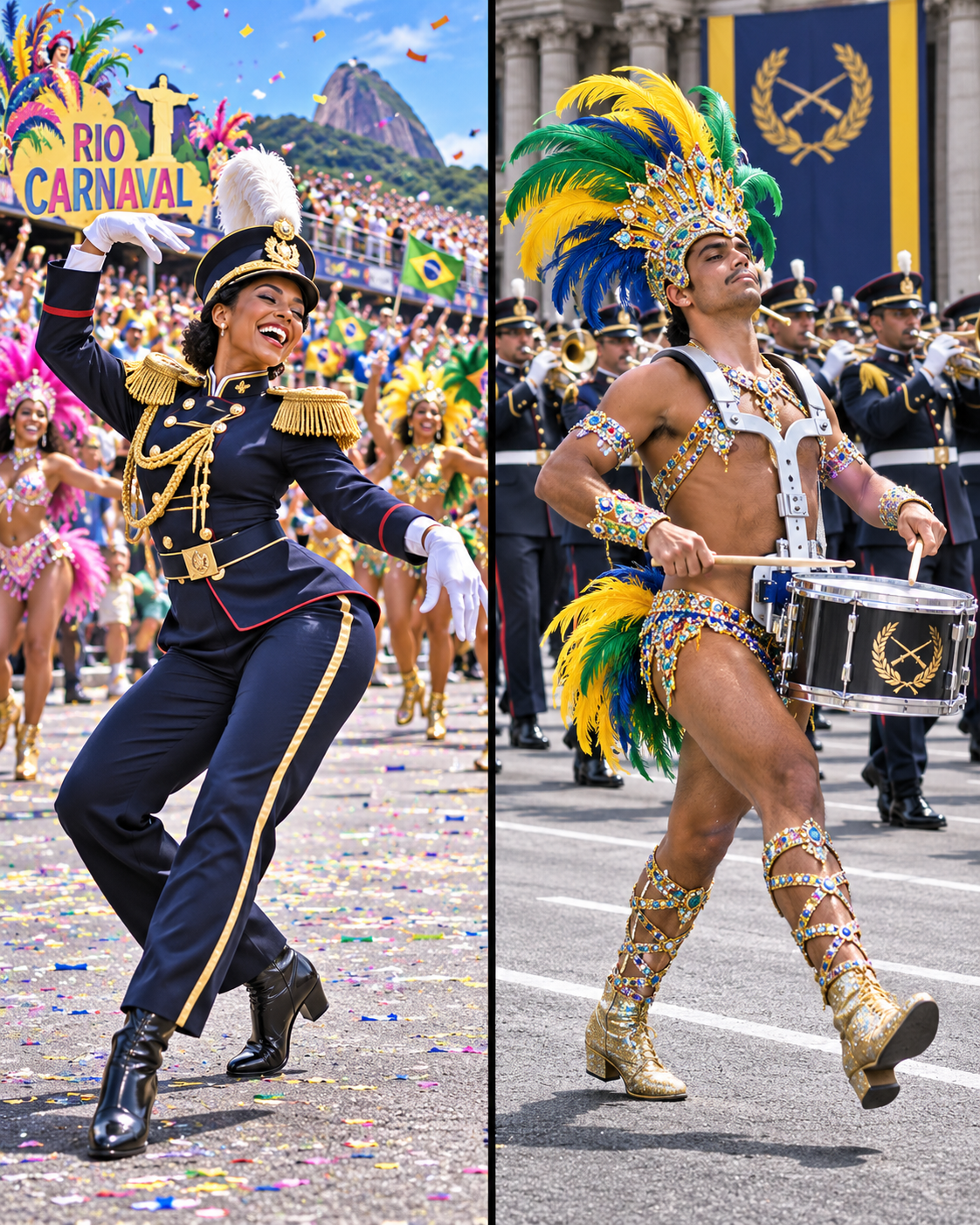
Brazilian Samba Vs. A Military March
As an answer to the wrenching question: what the hell am I doing with my time and where the hell do my days go. Every day takes a turn of its own. Mostly extremely twisted. And it usually has an unexpected ultra-twisted information payoff like the fact that the Brazilian Samba and the military march share the exact same musical timing: 1, 2 – 2/4 (2 beats per measure). Absolutely useless information? Yes, but so fascinating to me! Why? Another mystery of the universe!
I spent half a day trying to figure out basic musical architecture. Roughly, I was mistaken a beat for a drum kick 🙂
What I learned:
Any musical piece is like a tiny architectural piece.
The Foundation is a pattern of beats and the way they are organized (measure).
The Layer on top is a pattern of sounds – rhythm.
The pattern of beats (musical time) is different from the pattern of sounds (rhythm) 🙂 But they are interconnected.
The count tells you WHERE you are in musical time. The rhythm tells you WHAT happens during that time.
Let’s use your architecture metaphor again.
1. Count = the numbered beats
Imagine a song in 4/4 time, like bachata.
1 — 2 — 3 — 4 | 1 — 2 — 3 — 4
These numbers represent regularly spaced beats.
You’re simply numbering the ticks of the musical clock.
2. Rhythm = the pattern of sounds and silences
Now imagine a drummer playing over those four beats.
The underlying pulse stays perfectly regular:
Count: 1 — 2 — 3 — 4
But the drummer can play different patterns:
Rhythm A: BOOM — BOOM — BOOM — BOOM
Rhythm B: BOOM — (silence) — BOOM — (silence)
Rhythm C: BOOM — ta-ta — BOOM — ta-ta
Notice that rhythm C has extra sounds between the numbered beats.
The count hasn’t changed. The rhythm has.
3. The architecture analogy
- Pulse: The regularly spaced columns supporting your building.
- Count: The numbers assigned to those columns.
- Meter: How those columns are grouped into sections.
- Rhythm: The arrangement of elements within and between those columns.
4. And here’s the fascinating connection to dancing
You can dance to the same four-count music in completely different ways.
For example, you could:
- Step on every beat: 1, 2, 3, 4
- Step only on beats 1 and 3.
- Make additional quick movements between beats.
The musical count remains unchanged.
But your movement rhythm changes.
That’s why rhythm and count are not interchangeable.
The simplest way to remember it:
❤️ Pulse = the clock ticking.
🔢 Count = numbering those ticks.
🥁 Rhythm = the pattern of sounds and silences arranged around those ticks.
💃 Musicality = how you interpret and respond to those patterns through movement.
🏛️ Music as architecture
1. The foundation — Pulse and beat
Imagine the regular spacing of columns supporting a building.
TICK — TICK — TICK — TICK
- Pulse: The continuous, regularly recurring sense of time.
- Beat: Each individual tick of that pulse.
The pulse is not something separate from the beats. It’s the continuous pattern they form.
2. The structural organization — Meter
Now imagine grouping those columns into sections.
- 2/4: ONE-two | ONE-two
- 3/4: ONE-two-three | ONE-two-three
- 4/4: ONE-two-three-four | ONE-two-three-four
These groups are your measures.
The meter describes how the beats are organized.
3. The speed — Tempo
How quickly does that underlying clock tick?
That’s your tempo, commonly expressed in beats per minute (BPM).
Notice that tempo and meter are independent.
A waltz can be slow or fast while remaining in 3/4.
4. The patterns — Rhythm
Here’s one important element to add to your model.
Rhythm is how sounds and silences are arranged in relation to the pulse.
Some sounds land directly on beats. Others fall between them. Some stretch across several beats.
This is where syncopation comes in.
5. The materials and textures — Timbre and instrumentation
Now we’re getting to what you called the texture of music.
A violin, a piano, a kick drum, and a synthesizer can play the same note at the same moment, but they sound completely different.
That’s timbre: the characteristic quality or color of a sound.
Instrumentation is the choice of instruments producing those sounds.
6. The density and space — Musical texture
This is another interesting observation you made.
Music can be:
- Sparse: A few sounds separated by silence.
- Dense: Many simultaneous sounds, rhythmic events, or instrumental layers.
And silence is not simply the absence of music. It can be an intentional part of the musical composition.
A pause can create anticipation, tension, or emotional impact.
Think about a kizomba track where the bass suddenly drops out for a moment.
The pulse may continue in your mind, even though the instrument that was emphasizing it has disappeared.
When the bass returns, the impact can feel much stronger.
One final architectural element
There’s also melody and harmony.
If rhythm organizes musical events in time, melody and harmony help organize musical pitches.
And above all of these sits musical form: the larger organization of a composition into sections, phrases, repetitions, and contrasts.
So your architectural model becomes:
Foundation: Pulse and beats
Structural organization: Meter and measures
Speed: Tempo
Patterns: Rhythm
Musical materials: Melody, harmony, timbre
Texture: Instrumental layers and density
Space: Rests, pauses, and silence
Overall design: Musical phrases and form
You May Also Like

Letter to Myself: Ghost-Written

Go With The Flea
